
In short
- A roll out meets every personality on the team at once, so a single announcement rarely lands for everyone.
- Resistance to new technology is usually about uncertainty, fear of failure or job status, not the tool.
- First movers ask “can I try it?” before the demo ends. Detail-oriented skeptics come later, and once their questions are answered they are usually the biggest fans.
- Use-case questions mean adoption is taking hold. “Will it even load?” questions mean a barrier to fix first.
- What leadership can give a new tool is time, not a mandate.
When your team gets a new tool, what usually happens first? We put that question to a live audience during an Expert Xchange conversation with Andrea Burda, who works on organizational development and change management within DB Systel GmbH’s Immersive Technology team. The answers say a lot about how technology adoption really starts.
New Technology Rollout Poll: What Happens First When a Team Gets a New Tool
Here is how the live audience poll came out ([N] respondents):
- 47 percent: most people wait and watch
- 40 percent: a few people jump in immediately
- 13 percent: someone official has to mandate it
- 0 percent: it gets ignored until someone is forced to use it
That last number might be the most interesting one. Nobody in the room picked the option where a tool sits ignored until someone is forced to use it. Everybody has watched a roll out stall, or watched one take off, they just disagree on how it usually starts.
The full conversation is on the session page: The Human Side of Digital Transformation.
Why Employees Resist New Technology, and Why It Is Rarely About the Tool
In Burda’s experience, the fear of a new workflow is usually about something deeper than the software. That matches what change management practitioners report more broadly.
Common causes of resistance to new technology
Most resistance traces back to a short list of worries, according to a change management guide from Relay:
- Uncertainty: nobody has said what the new workflow will ask of them
- Fear of failure: looking slow on a tool everyone can see
- Job status: concern about how the tool changes their role
When resistance to new technology peaks
The same guide notes that resistance spikes at predictable pressure points:
- When old tools are removed
- When performance is measured in new ways
- During peak operational periods
Read this way, resistance is information about where a roll out is asking too much, too soon.
Big Five Personality and Technology Adoption: Reactions to Change, Not Labels
A personality framework is an unusual place to start a conversation about enterprise software, but it’s the right one. Burda leans on the Big Five, the same framework used across organizational psychology more broadly, to make sense of something every roll out runs into: treating everyone on the team the same is often where the trouble starts.
What the Big Five personality model measures
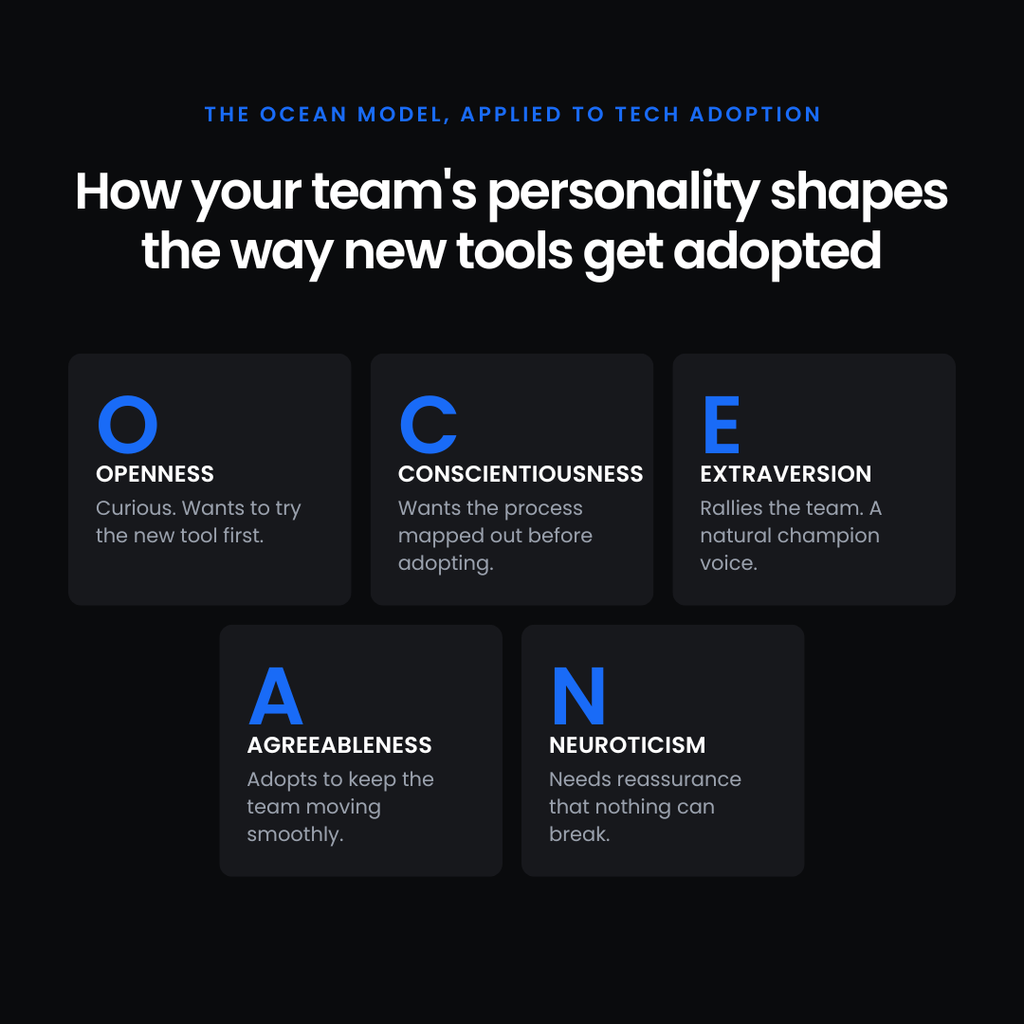
The Big Five describes personality as five dimensions, not five types of people. Everyone sits somewhere on all five, so a team is a spread of combinations and a roll out meets all of them at once.
- Openness: curiosity and appetite for novelty
- Conscientiousness: diligence and attention to detail
- Extraversion: energy in social settings
- Agreeableness: willingness to cooperate
- Neuroticism: proneness to worry and stress
Each one is a spectrum, and most people land somewhere in the middle. That is why the model describes tendencies rather than verdicts.
Technology acceptance research has started to test this. A study of AI adoption in Frontiers in Artificial Intelligence found that openness correlated with how easy people judged a tool to use.
Why one roll out plan for everyone stalls technology adoption
“It’s not really about labeling people,” as Burda put it, “but it’s really to understand reactions to change, to understand what those people need.”
Read that way, a reaction to a new tool is a signal about what the person needs next, not a judgment on the person.
Technology Adoption Curve vs the Big Five: When People Adopt and Why
Two frameworks often get mixed up here, and they answer different questions.
The five adopter categories on the technology adoption curve. Everett Rogers’s diffusion of innovations sorts people by when they adopt, with these shares of a population:
- Innovators: 2.5 percent
- Early adopters: 13.5 percent
- Early majority: 34 percent
- Late majority: 34 percent
- Laggards: 16 percent
Geoffrey Moore’s chasm is the gap between the early adopters and the more cautious early majority.
The curve tells you who adopts early. It does not tell you why a careful person hesitates or what would move them. The Big Five gives you dimensions to reason about that need, which is the use Burda describes.
Treat the two as complements: the curve for timing, the Big Five for what each person needs next.
Early Adopters and Skeptical Employees: Who Shapes a New Technology Rollout
Two groups tend to matter most, and they show up at different points.
Early adopters: the people who ask “can I try it?”
Early on, it’s the people already asking “can I already click here? Can I try it out?” Before the demo’s even finished, they are the natural first movers, and the ones worth approaching first.
Detail-oriented skeptics: hard questions that look like resistance
Later, and more consequentially, come the detail-oriented skeptics, the ones asking the harder questions that can look like resistance but rarely are. Prepare for those questions in advance, and Burda says “usually those are the biggest fans in the end. They spread the links themselves, then we don’t even have to do the work ourselves.”
The practical version of this is in the FAQ below: sit down with the most skeptical people early, one-on-one.
Technology Adoption Signals: Use-Case Questions vs Barrier Questions
There’s a moment in every roll out where you can already tell which way it’s headed, and it comes down to the kind of questions people start asking.
Use-case questions show the tool is fitting into real work
When the questions turn toward use cases, “could I use it for this? Can I use it for that?”, that’s the tell. The conversation has moved past the technology itself and into something more useful: how it fits into the way people already work.
In technology acceptance model terms, this is perceived usefulness taking hold.
Load and laptop questions show a barrier problem, not a value problem
The opposite pattern is just as recognizable. If people are still stuck on whether it will even load, or whether their laptop can run it, that’s a barrier problem, not a value problem. There’s more groundwork to do before the tool earns anyone’s trust.
In the same model, this is perceived ease of use still missing.
360 Camera vs LiDAR Capture: Matching the Method to the Job at DB Systel
Prevu3D and DB Systel GmbH have worked together for several years, long enough to get concrete about how the two capture technologies at the center of that work actually get chosen.
“We don’t skew toward any capturing method. We looked at it also from the value perspective,” meaning the technology gets matched to the problem, not chosen by default.
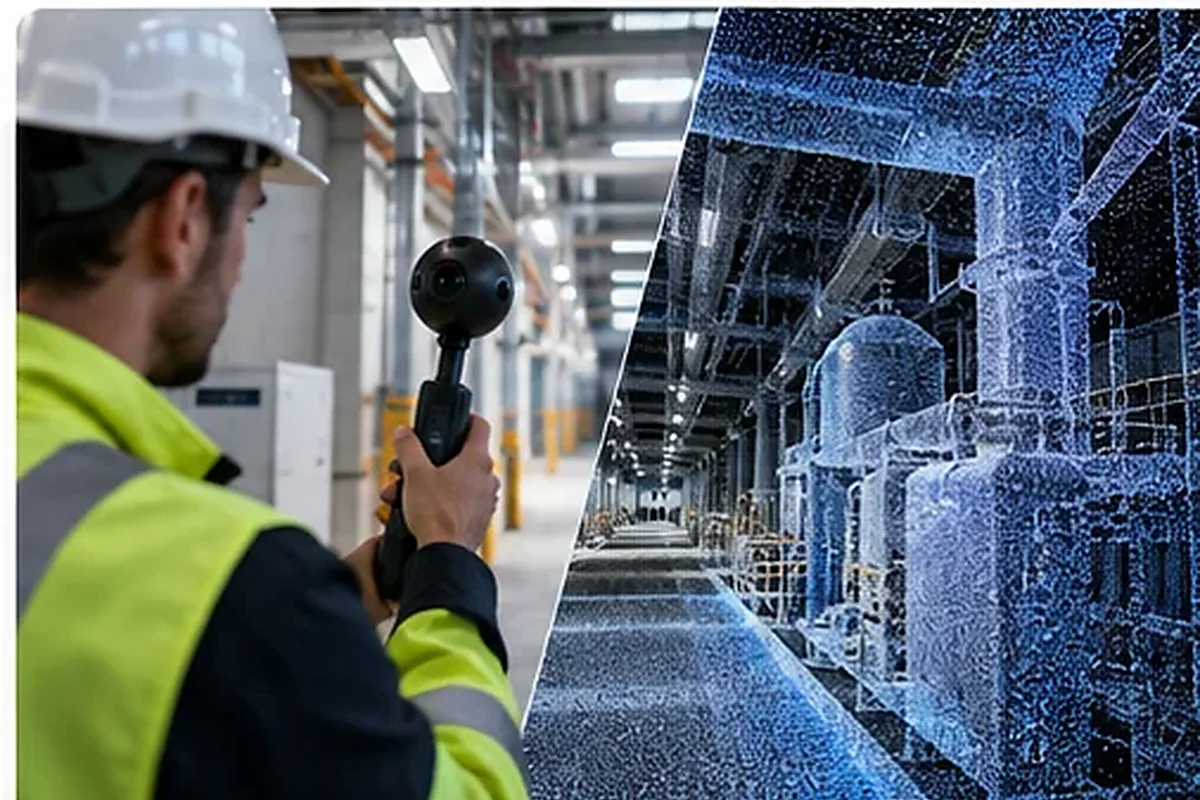
For getting maintenance teams oriented at a station before a visit, 360 camera capture wins because “it’s quite intuitive, you just look around, people can get familiar with the stations.”
In practice, a maintenance team reviews a walkthrough of a station before ever setting foot there, and uses it to:
- Check safe crossing points
- See where tracks end
- Spot which assets need attention
Burda added: “Even if there are further questions, we can jump from the 3D model into different links and dig deeper if needed.” For more on how that partnership scaled, read the DB Systel 360 camera reality capture case study.
LiDAR capture for precise measurements and geometry
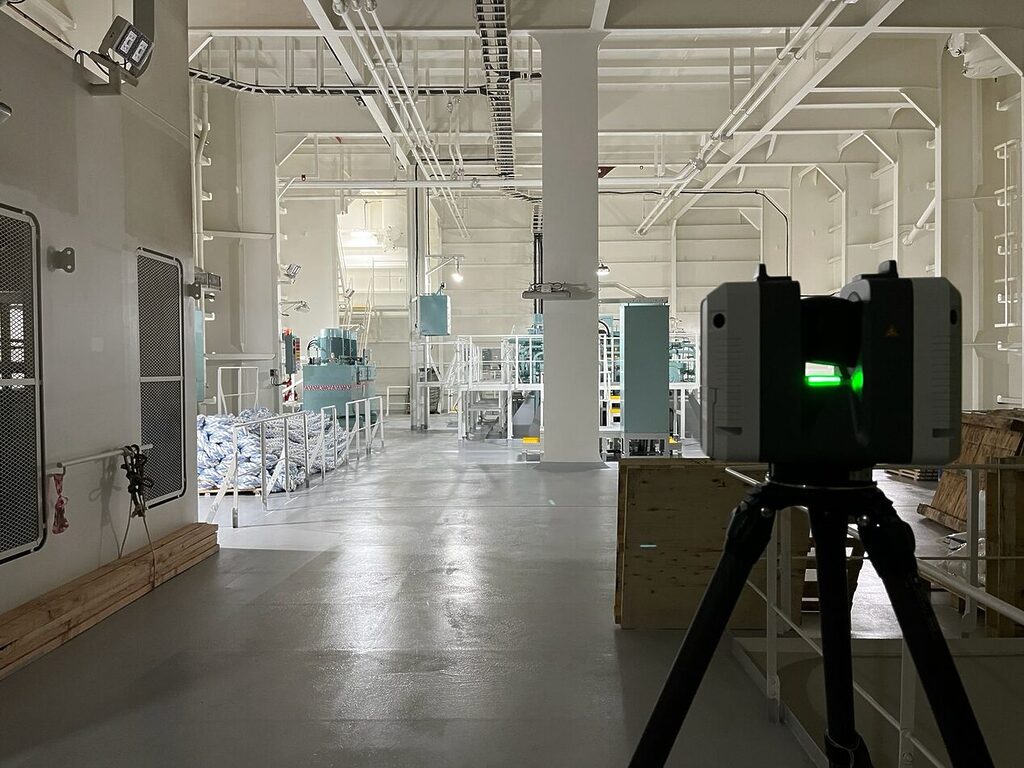
For work requiring precise measurements or geometry, LiDAR earns its place instead. The decision logic behind that split is laid out in 360 camera vs laser scanner: when to grab the camera, and when to call in the crew.
Technology Adoption Leadership: Why Time Beats a Mandate
Ask what leadership can actually do to help a tool get adopted, and the answer isn’t about mandates or top-down pressure. It’s about time.
“It’s not, okay, we pull up one info slide and then maybe one how-to video and everyone is ready to use it,” says Burda. Getting people who sit differently on those five dimensions comfortable with something new takes longer than a single announcement, and the payoff for that patience shows up later, once most of the early questions have already been answered and the tool has become part of how people already work.
For teams planning the move from a pilot to a program, the digital transformation solutions page shows where reality capture fits.
Putting Technology Adoption and the Big Five to Work on Monday
Adoption is a run of conversations with different people, not a single announcement. Plan it that way.
- Find your first movers and let them click. Approach the people already asking “can I try it?” first. They give the wait-and-watch majority someone to watch.
- Book one-to-one time with your most skeptical colleagues before launch.
- Ask for their hardest questions
- Log the gaps, then fix them or state the limit plainly
- Prepare the answers before the wider demo
- Sort every question into use-case or barrier.
- Use-case questions (“could I use it for this?”): collect them, they are your next examples
- Barrier questions (“will it load?”, “can my laptop run it?”): fix access before making the value case
- Choose the capture method from the decision, not the toolbox.
- 360 camera for fast orientation before a visit
- LiDAR for precise measurements and geometry
- Plan a sequence, not a slide. One info slide and one how-to video is not a rollout plan. Schedule a run of touchpoints instead.
- Avoid switching off the old tool during a peak operational period
- Re-read the team at each milestone. If the schedule slips, expect a more cautious room than the one you launched with.