
Reality capture has always been good at showing what a physical environment looks like. AI is now starting to understand what’s actually in it.
That shift changes what reality data is for. A scan stops being something you view, measure and then archive once the CAD model exists. It becomes context that AI agents, engineers and simulation tools can work from directly.
In our recent live session, What Happens When AI Understands Reality?, we showed where this stands today: Vision AI identifying assets, AI-powered Scan-to-CAD, human review built into the workflow, and reality delivered into the tools where decisions are made. Everything shown used general-purpose AI models, with no custom training.
This article covers the ideas behind those demos and where we see the industry heading.
Why Reality Data Is Becoming the Next Layer of Enterprise Data
Enterprise software is learning to read documents, databases and CAD models. The next step is for it to understand the physical world, and that requires reality data.
The traditional workflow treats a scan as a one-time input: capture the site, model it in CAD over weeks or months, then set the scan aside. But a scan holds information CAD never will: the actual condition of equipment, labels and tag numbers, wear, and everything that was never modeled.
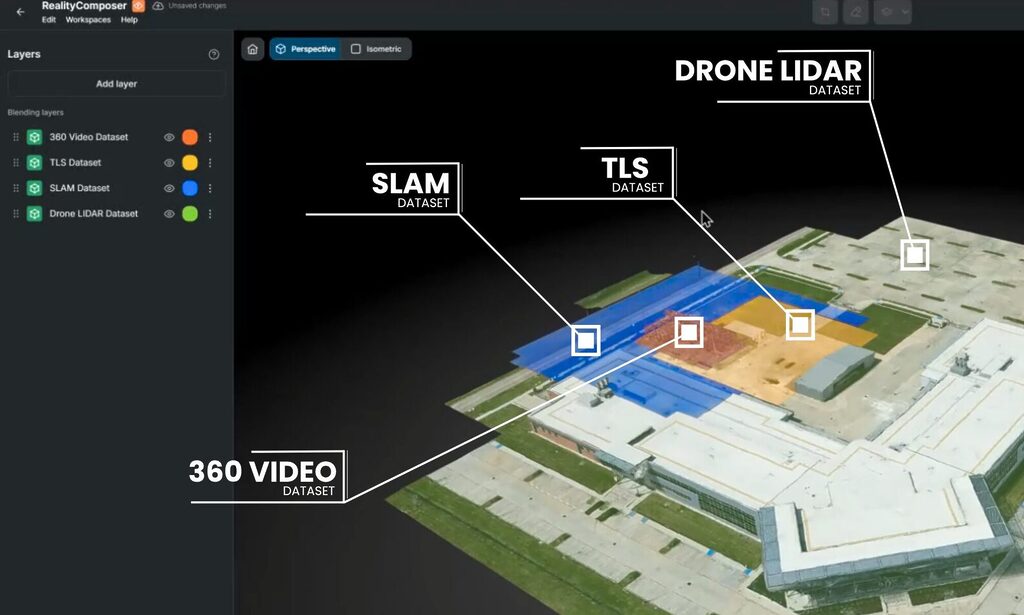
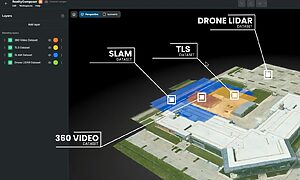
Capture is also becoming continuous. Terrestrial laser scanners, SLAM, drones, 360° cameras and, increasingly, robots and AMRs all feed new data about the same facilities. The challenge is no longer capturing reality, but managing it as a living, up-to-date layer that engineering, operations and AI can all rely on.
The future is a continuously managed layer of reality that synchronizes the physical world to digital truth.
— Michel Besner, CEO, Prevu3D
The goal is to shorten the time between digitizing a facility and making decisions with it. The shorter that gap, the faster teams can design, validate and plan against what actually exists.
Vision AI: Giving AI Agents Real-World Context
AI agents can only reason about what they can access. Through MCP (Model Context Protocol), RealityPlatform™ makes captured environments available to AI agents as context: point clouds, meshes, Gaussian splats, panoramic images, RealityAssets™ and asset libraries.
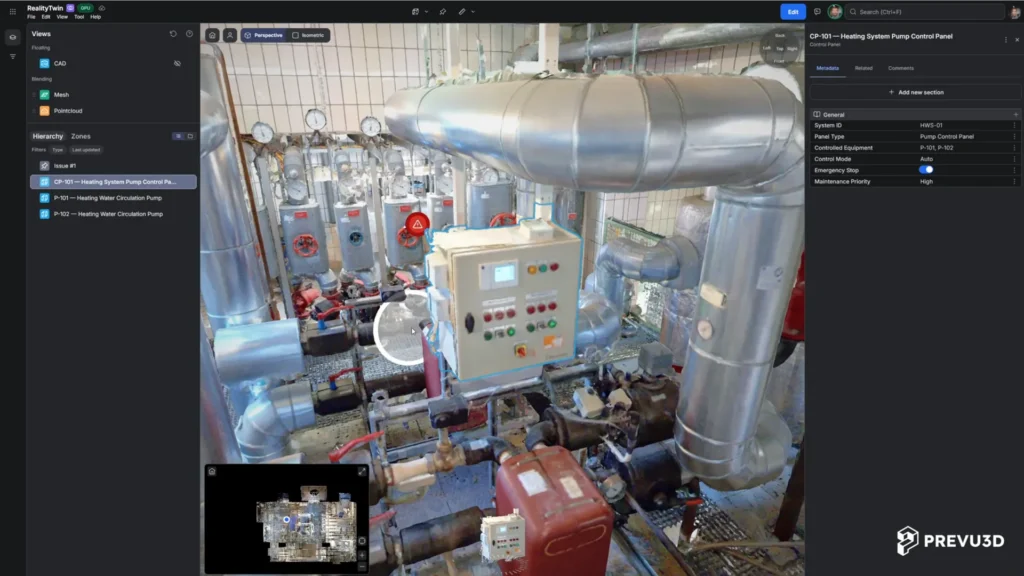
That context goes beyond 2D. An agent can move through a 3D scene, find the best viewpoint of an asset, read a label or tag number, and use that to identify and enrich the asset with metadata.
This works where people already use AI. Reality data can be brought into an AI assistant’s conversation, so users don’t need to open a separate application. And if that assistant is already connected to other systems, such as an equipment register, it can compare what’s recorded with what’s actually on site.
In complex piping environments, current models already identify flanges, valves and pumps, and infer how they connect.
It’s finding the flanges, the valves, and it’s also creating relationships, like knowing there’s a pump over here and a pipe going all the way to this valve. And it’s only getting better.
— Philippe Bédard, Director of Product, Prevu3D
AI-Powered Scan-to-CAD, Without Custom Training
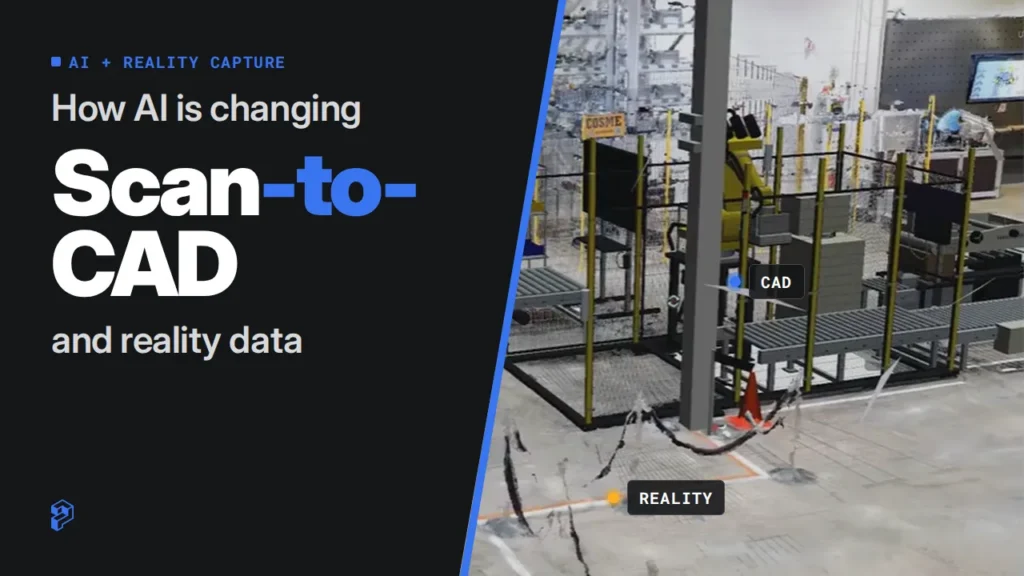
Scan-to-CAD has long been a specialized, manual process. AI is changing that: in one demo, AI agents reconstructed an entire industrial scene as CAD in about 24 hours, with no custom training, no scene preparation and no manual modeling.
AI agents reconstruct an industrial scene as CAD, with no custom training.
The key is context. A mesh handed to an AI model on its own gives mixed results. With access to the full platform, several agents work together: one checks a panoramic view, another an orthophoto, another the mesh, each pulling what it needs before generating geometry.
The output fits existing workflows. Agents can generate IFC, Revit, JT or USD, and follow a team’s own structure when given an example to work from. Results depend on input quality: denser point clouds and cleaner meshes produce better CAD, whether the source is laser scanning or photogrammetry.
Matching Scans to Your Existing CAD Libraries
Not every asset needs to be modeled from scratch. When a matching asset already exists in a CAD library, in RealityPlatform, Teamcenter or Forma, AI agents can find it and place it in position in the scan.
Matched assets (yellow) placed from an existing CAD library.
Reusing assets keeps models consistent with company standards and reduces the cost of running AI agents. The more complete the library, the less there is to generate.
Human-in-the-Loop AI: Why Control Builds Trust
There’s no shortage of “magic button” AI.
But engineers can’t build on output they can’t explain. What we hear from customers is consistent:
“We still need to have control to have trust.”
— Prevu3D customers, as shared by Michel Besner
That’s why explainability is built into Workbench, Prevu3D’s new AI workspace. Users see what the AI identified, the decisions it made and why, not just the final result.
Comparing AI-generated CAD against the scan in Workbench.
From there, review is part of the workflow:
- Compare AI-generated CAD against the scan to see how well each asset fits.
- Re-prompt the AI to fix what’s off: a missing component, a misplaced part.
- Correct manual models too, such as a section of CAD that no longer matches the scan.
- Hand off issues through integrations like Forma, so the right person fixes them in Revit, AutoCAD or Inventor.
As models improve, more of this will run automatically. Review keeps it usable at scale in the meantime.
One Asset, Many Representations
No single format captures everything about a physical asset, so RealityPlatform keeps several representations tied to the same object:
- Point cloud to measure against the original capture
- Mesh for clear edges and lightweight geometry
- Gaussian splat for the highest visual fidelity, especially for non-technical audiences
- CAD for engineering
Switching between point cloud, mesh, Gaussian splat and CAD for the same asset.
Each representation also gives AI something different. A mesh shows edges a point cloud can’t, and high-quality imagery reveals labels and conditions. Combined, they give AI models far more to reason with than a point cloud alone. Teams can mix them too: a whole facility as a Gaussian splat, with the production line in CAD.
Reality Inside Your Design, Engineering and Simulation Tools
Viewing reality data in a separate application only goes so far, because that’s not where the work happens. Prevu3D delivers reality directly into the tools teams already use, including Revit, AutoCAD, Forma, Teamcenter, Process Simulate, Plant Simulation and NVIDIA Omniverse.
In one example, a robotized machine was recreated as CAD with AI, and its robot arm made animatable. The model went into Siemens Plant Simulation, while the rest of the facility was streamed in as visual context.
AI-generated CAD in Siemens Plant Simulation, with the facility streamed in as context.
Streaming matters because loading a full facility scan into most design or simulation software isn’t practical. RealityConnect™ streams the surrounding environment in real time and brings in only the specific objects the task needs. The same works in Omniverse, Revit and Forma.
When you start seeing these types of demos, where reality is fully embedded into your design and simulation software, you don’t want to go back to something that doesn’t have it.
— Michel Besner, CEO, Prevu3D
AI Governance: Your Models, Your Data
AI use is moving faster than AI policy. In a live poll during the session, 76% of attendees said they use AI daily, but only 25% said their organization has an AI strategy and guidelines in place.
Prevu3D is built so IT teams stay in control:
- Bring your own model. RealityPlatform works with any MCP-compliant AI model, including open-source options, so teams can use the models and licenses they already govern.
- No training on customer data. The demos shown used general-purpose models, unmodified. Customers who want better results can train or enrich their own models.
- Private cloud deployment. A virtual private cloud option, running in an AWS environment the customer’s IT controls, is coming in the new year.
Why Prevu3D Builds the Platform, Not the AI Model
Frontier AI models are improving month over month. Rather than compete with them, Prevu3D focuses on the hard part they don’t solve: managing reality data at scale and connecting it to the tools and AI systems enterprises already use.
Instead of investing in engines or algorithms, we said: let’s build the plumbing, the platform, the framework that makes it possible to leverage these frontier AI models, and bring the human back into the loop
— Michel Besner, CEO, Prevu3D
That foundation is what turns a one-off demo into an operational workflow. Generating an IFC file from a scan is one step. Keeping it aligned when the facility is scanned, bringing it into Revit and simulation, and tracking what changed is where most of the effort still goes.
Every improvement in AI models makes that foundation more valuable. As capture becomes continuous and models become more capable, reality data will stop being something teams go and look at. It will be part of every design, engineering, simulation and operational decision.
See AI Scan-to-CAD from Prevu3D in Action
The full session includes every demo covered here, plus live Q&A on open-source models, file formats, photogrammetry and streaming into Revit and Forma.
Want to see how this applies to your facilities and workflows? Book a discussion with our team.