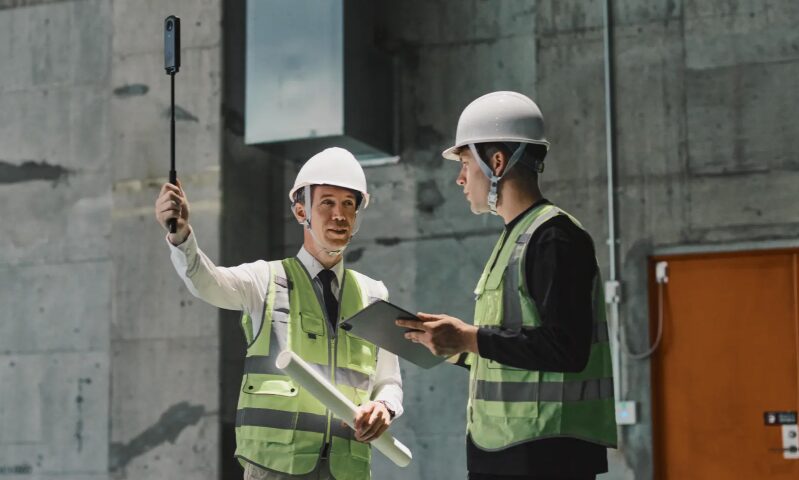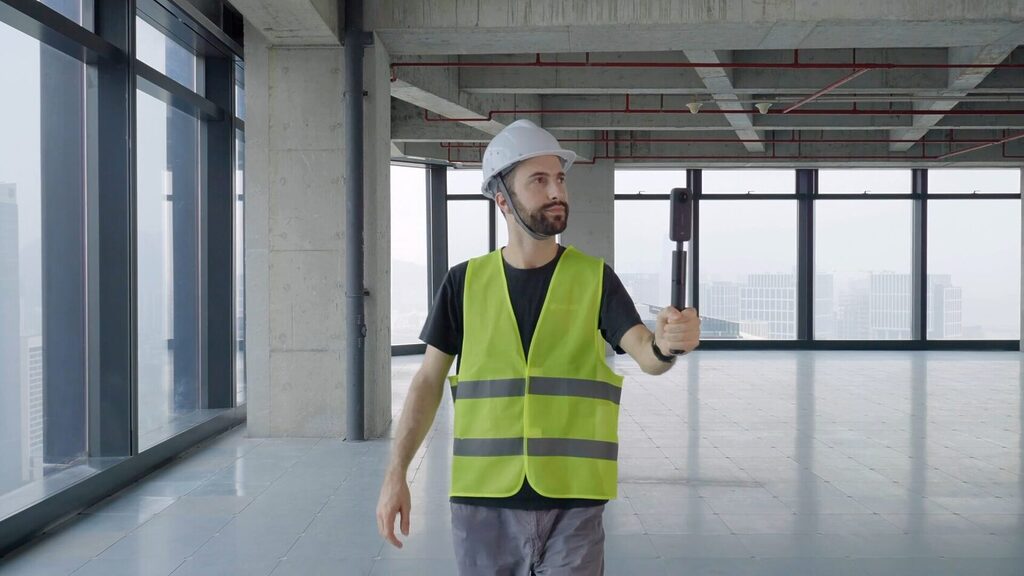






Today, reality capture is still surrounded by friction. A site gets scanned. Then people wait.
- Data needs to be processed.
- Models may need to be reconstructed.
- Assets need to be identified and organized.
- Files move between systems.
Engineering teams wait for usable information before they can get to the work they actually need to do.
Engineers want to plan a new layout, validate an engineering decision, prepare a simulation, train people or operate the facility, not spend their time preparing reality data.
As reality capture becomes an enterprise-scale process, this model doesn’t scale. Capturing more frequently or across hundreds of sites only creates more data, more hand-offs and more waiting.
Point cloud to mesh to classified CAD: the 24 hour run
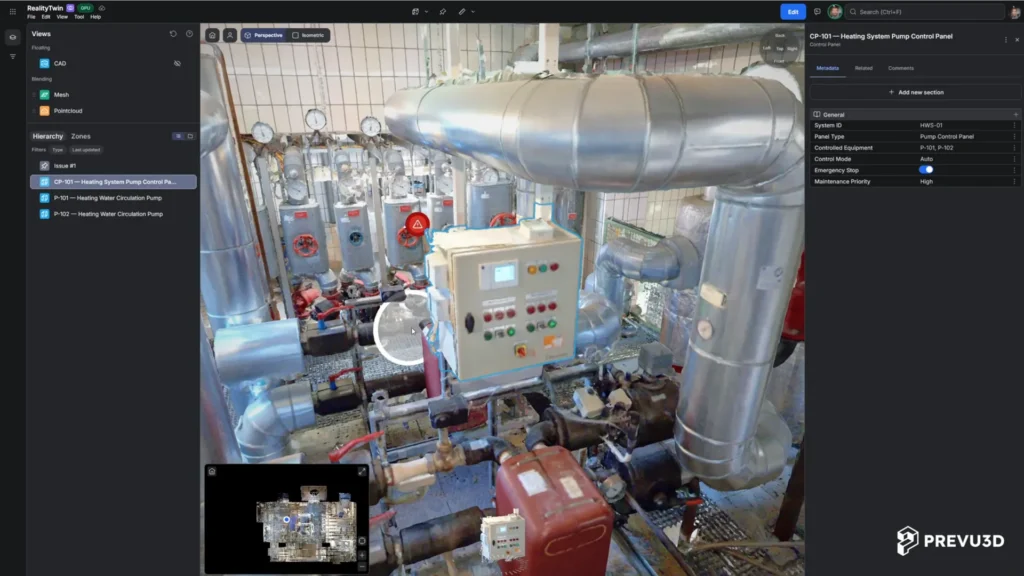
When NavVis released the VLX4, they gave our team access to a sample dataset. Within less than 24 hours of receiving the dataset, we used RealityPlatform to create a high-fidelity mesh of the environment, segment and classify what was captured, and experiment with AI-generated 3D CAD. We then brought both reality and CAD—spatially aligned—directly into Autodesk Revit.
Some of these capabilities are already part of RealityPlatform, while others represent new workflows and automation we are actively developing. What matters is seeing how quickly the entire process can come together as one connected experience.
Watch one capture become an aligned Revit model
The significance isn’t any one of these capabilities. It’s what happens when the entire process becomes seamless, automated and connected.
RealityPlatform manages the physical environment and its different representations: point cloud, mesh, Gaussian Splat, RealityAssets and CAD. AI can increasingly understand and generate information from that reality.
RealityConnect then makes it available directly inside the applications where people actually work.
Instead of users managing reality data, converting files and waiting for models to be prepared, the infrastructure increasingly does that work for them.
Why a viewer cannot deliver a classified environment
Viewing reality data is only one small part of the workflow. The bigger challenge is everything that needs to happen after capture to make that reality usable across the enterprise. A platform approach changes that.
Reality can be processed, structured, segmented, classified, transformed into different visual representations, augmented with AI-generated CAD, and connected directly into the applications where people actually work.
Instead of asking users to manage scan data or move into a separate viewer, the platform manages the complexity behind the scenes and delivers the right representation of reality where it is needed.
The goal isn’t to help people spend more time with reality data. It’s to make reality data seamlessly available so they can spend more time designing, planning, simulating, training and operating.
Companies like NVIDIA, OpenAI, Anthropic and others are investing billions to solve increasingly complex vision, reasoning and generation problems, and those models will continue to improve at an incredible pace.
Our focus is to build the reality infrastructure that allows their models, and whatever comes next, to understand and act on the physical world at enterprise scale.
Our goal is to build the reality infrastructure that allows the best AI models to work with the physical world at scale.
What AI models do not provide
AI models are incredibly powerful, but they don’t provide the platform required to manage massive reality datasets, maintain spatial context, organize and persist assets, manage multiple representations, connect reality with enterprise information, or deliver the results into engineering systems.
That’s the role RealityPlatform is being built to play. Providing a framework where reality can be captured, structured, segmented and connected, then made accessible to the best AI models as they emerge. The intelligence can evolve without having to rebuild the underlying reality infrastructure every time a better model appears.
What AI-generated CAD makes possible next
AI-generated CAD is an exciting demonstration of what this makes possible, but it’s only the beginning. The same foundation can enable automated asset understanding, metadata generation, change detection, validation, engineering analysis and entirely new workflows we haven’t imagined yet.
The opportunity isn’t to build the best AI model. It’s to build the reality infrastructure that allows the best AI models to work with the physical world at scale.
From capture to aligned CAD in 1 day: what changes for engineering teams
None of this happens without great capture, and the quality of the VLX4 dataset gave us an incredible foundation to work from.
But what happened in the following 24 hours is the bigger story.
Reality was processed, structured, segmented and classified. AI was used to generate CAD. Reality and CAD were then brought together, spatially aligned, directly inside Revit.
Not as a collection of disconnected tools and manual steps, but as a connected platform-level workflow.
Where the reality capture industry goes from here
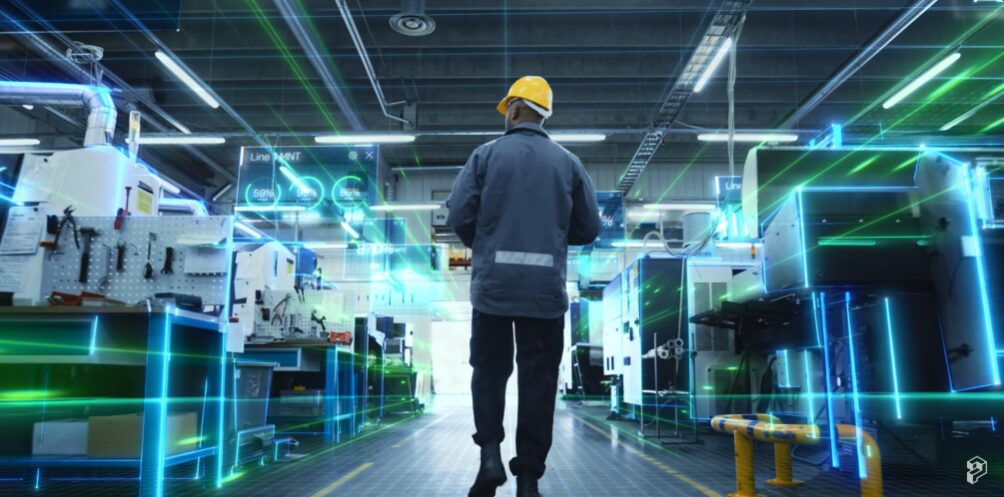
This is where we believe the industry is going. Capture technology will keep getting better. AI models will keep advancing at an incredible pace. The opportunity is to connect those innovations through an enterprise reality data layer that can manage the physical world at scale and make it available wherever people and AI need it.
CAD generation is just one early example of what becomes possible.
Less waiting. Less manual preparation. More automation. And reality seamlessly connected to the work that actually needs to get done.
That is Seamless Connected Reality — and we’re just getting started.