
Somewhere right now, a major US electrical utility has more than 1,500 substations captured as point cloud data. Survey teams captured the facilities with 3D laser scanning, registered the point cloud data with precision, and delivered the final datasets to the utility. The utility owns a detailed digital record of its infrastructure. Yet in many cases, that valuable reality capture data remains inaccessible to the engineers, planners, and operations teams who need it to make decisions.
And it has done almost nothing, because the people who need to act on it can’t open a point cloud file, don’t have the software, and don’t have the ten years of training it takes to navigate a sea of points without getting lost.
Why Industrial Digital Transformation Projects Stall
This is the real bottleneck in industrial digital transformation. Not the capture. The scan is the easy part. What breaks down is everything after: delivery, access, decision-making, adoption. The gap between a point cloud on a server and a facility team that actually knows what they have is where most digital transformation initiatives quietly stall.
Digital Twins Turn Spatial Data Into Decisions
At CES 2025, the Siemens CEO took the stage alongside the CEO of Nvidia for a keynote on AI and digital twins.
The centerpiece case study was PepsiCo, which demonstrated how digital twins accelerate decision-making. By digitizing facilities and working within accurate 3D spatial data from day one, PepsiCo’s teams validated layout options and made critical planning decisions weeks before CAD models were complete.
One specific project explored whether existing warehouse facilities could accommodate an additional layer of racking. A fifth layer on a four-layer system means 20% more storage capacity without building anything new. They validated it digitally, made the decision fast, and moved.
From Reality Capture to Operational Efficiency
The result was a 20% efficiency gain across those facilities. The first step in achieving it was scanning the space.
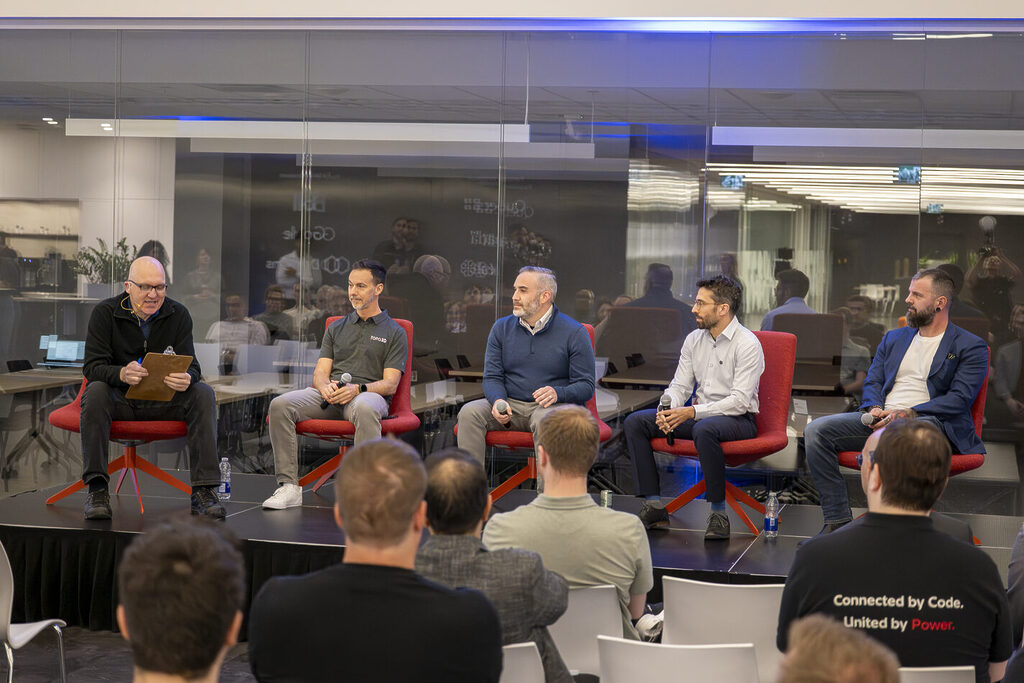
That’s what’s possible when captured data actually reaches the people making decisions, in a form they can use. Four practitioners who operate at this intersection every day ( a surveyor, a CAPEX engineer, a reality capture manager at WSP, and a technology leader at Tetra Tech) recently sat down to talk about what that looks like in practice. Here’s what they said.
In manufacturing, the clock starts before the scanner does
Construction and manufacturing look like the same job from the outside. They’re not.
In construction, a missed scan setup means coming back tomorrow. In manufacturing, it can mean waiting a year. Jonathan Bouffard, Principal Partner at Topo3D, has been doing reality capture for 14 years. When his work shifted from infrastructure into industrial facilities, everything about project planning changed.
You might have one hour. We did 200 scans in a single hour at a manufacturing plant—seven scanners running simultaneously. In infrastructure, if you don’t finish, you come back. In manufacturing, you don’t have that luxury.
— Jonathan Bouffard, Principal Partner, Topo3D
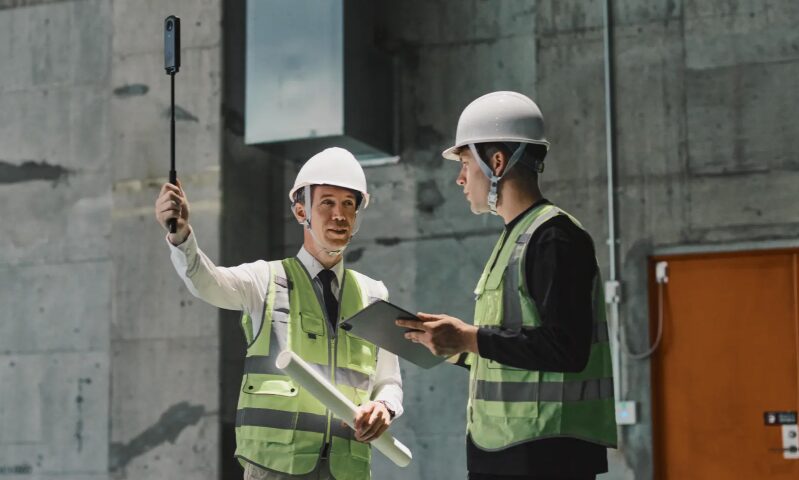
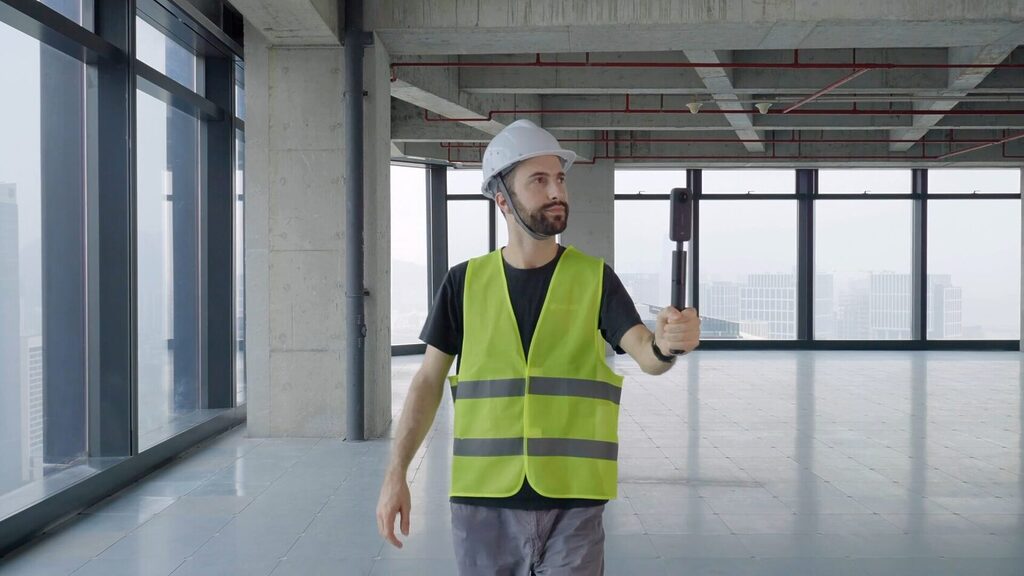
The pre-capture walk at a noisy industrial facility happens in silence. Bouffard’s team uses a 360-degree camera because conversation is impossible on the floor. The planning session happens off-site, reviewing footage. Every setup position is mapped before a scanner is unpacked.
Adam Moutafis, Reality Capture Manager for the Southern US at WSP, has a project coming up: a 15-day plant shutdown, 3.5 million square feet to capture. When that facility comes back online, the window closes for another year. Sébastien Cliche at Tetra Tech has scanned pharmaceutical environments where the available downtime was 2 a.m. to 3 a.m. One hour. That’s it.
The discipline required is categorically different from any other environment. Digital transformation in an industrial facility begins the moment the surveyor walks the floor. Not when any software is opened.
Data that reaches one person reaches nobody
The substation problem Moutafis described isn’t an anomaly. It’s the default outcome when point cloud data is treated as a file delivery rather than a shared operational asset.
Even my kids look at my point cloud work and ask how I know what I’m looking at. I tell them: ten years, that’s how. But put it in 3D and anyone can understand spatially what’s going on. The context is just there.
— Adam Moutafis, Reality Capture Manager — Southern US, WSP
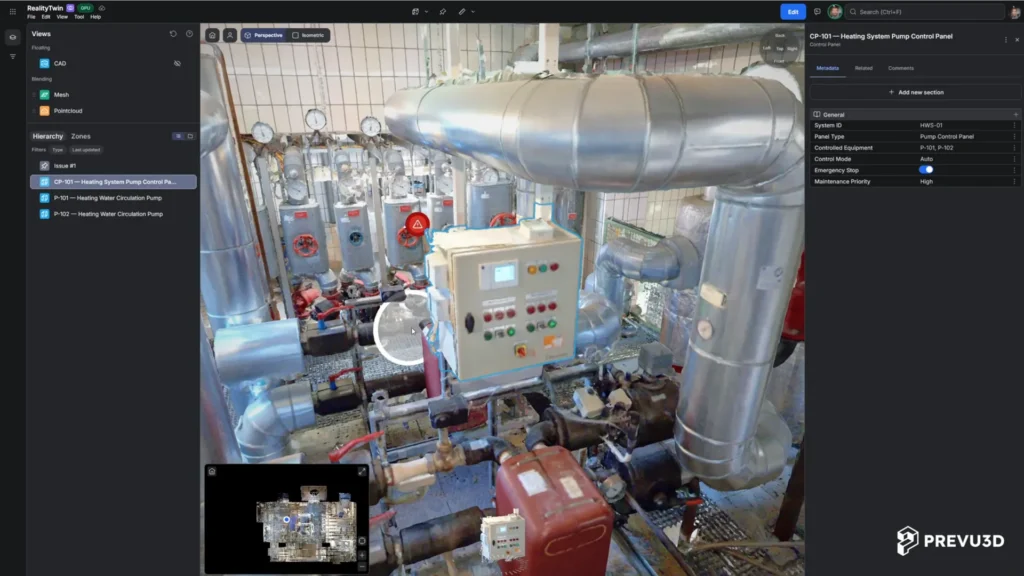
When a point cloud is delivered as a proprietary file to one specialist, it reaches one specialist. But when that same data is accessible as a navigable environment via a URL, shareable without software installs and openable by the maintenance manager, the ops director, and the engineer planning next year’s capital project, it becomes something the whole organization can use.
Bouffard puts it directly: clients who commission a scan are often sitting on far more value than they realize, because they’re thinking about one deliverable for one person. Prevu3D changes the delivery model. The data doesn’t change, but the reach does.
If you don’t get that data in front of the people who need it within the first few days, you lose the window. Everyone has 30 projects on their mind. It goes in the backlog and sometimes never comes back out.
— Adam Moutafis, Reality Capture Manager — Southern US, WSP
Accessibility isn’t a nice-to-have. It’s the difference between data that drives decisions and data that collects dust.
Model what matters. Leave the rest as mesh.
A full BIM model of an industrial facility is expensive, slow, and most of the time unnecessary. The targeted approach works differently: model only what a specific decision requires, and leave everything else accessible as geometry. Faster, cheaper, and more likely to actually happen.
Moutafis gave the numbers plainly. A client says they want a model of their substation. What they actually need is two transformers modeled. The rest is noise.
Targeted modeling: seven working days, under $10,000. Full model proposal: $40,000 to $50,000—and it never would have happened. The client gets what they need. We move. Everyone wins.
— Adam Moutafis, Reality Capture Manager — Southern US, WSP
He now builds the cost into project proposals as a line item. Small enough as a percentage of overall bid that the question rarely gets asked, but delivering enough value that it’s become the standard opening move with new clients. A Trojan horse, he calls it. The work earns the relationship.
The shift this requires is reframing the client conversation: not how much does a model cost, but what decisions do you need to make, and what data does each one actually require. That’s a different sale. It’s also a more honest one.
Find the clash in design, not on site
In active industrial facilities, a clash found during construction execution is a completely different problem than one caught in design. One is a model revision. The other is stopped work, contractor calls, rescheduled equipment, and production downtime.
Malik Sammouda, President of Élémentaire Consultants, does CAPEX project management across the food industry: facility modifications, equipment relocations, production line reconfigurations. Almost always in active plants. Almost always under margin pressure.
It’s extremely rare to have an accurate as-built when you start a project. Scanning gives you the environment immediately. You can do two or three design iterations before you even present to your client—something you simply could not do in the field.
— Malik Sammouda, President, Élémentaire Consultants
The digital environment doesn’t just surface clashes earlier. It changes who’s in the room when decisions get made. Sammouda describes client reviews where the people who actually run the facility, the ones who know the plant in their bones, can walk through a planned installation digitally, see what the contractor will encounter, and raise the practical constraints that never appear in a drawing review.
Someone around the table says, ‘Did you think about this constraint?’—something that would normally show up as a problem on site. That’s the kind of thing you want surfacing in the conference room, not during mobilization.
— Malik Sammouda, President, Élémentaire Consultants
There’s a second-order benefit that often gets overlooked: scope documentation. A scope of work built from a digital twin, with annotated geometry, clear spatial relationships, and visual references, produces contractor bids based on what they’ll actually encounter. That’s fewer change orders and surprises for a cleaner project.
Adoption happens when the tool is simply better
Sébastien Cliche, Innovation & Technology at Tetra Tech, has introduced a lot of new tools into large engineering organizations. His read on what actually drives adoption is less about technology and more about the moment when a person stops using the old way because the new way is just obviously better.
The moment clients can see their facility in a way they’ve never seen it before—that’s when the conversation shifts. They start sending the link to their team. They start seeing what they actually have.
— Sébastien Cliche, Innovation & Technology, Tetra Tech
The example he gave was striking: infrastructure maintenance professionals, old-school technicians accustomed to paper-based documentation and manual tagging.
When presented with a sufficiently detailed navigable environment, they stopped using their paper records. Not because anyone told them to, but because the digital version was faster and more accurate than what they’d been doing for years.
On AR and VR, Cliche is measured. Mobile AR has real operational value in regulated environments where a headset would create safety and compliance issues; an iPad on the floor is practical where a vision-restricting helmet is not. Full VR has a role in stakeholder presentations, the wow moment that wins a bid. But the ROI on VR hardware and training doesn’t yet justify broad deployment for most industrial use cases. The technology is there, but the economics aren’t.
His cleaner framing: a well-built navigable 3D environment does most of what VR promises, without the headset, without the training, and without the budget line.
The questions clients don’t know to ask
The most useful question from the audience wasn’t about technology. It was about motivation: why do clients actually undertake this? What’s driving the decision?
The answers: Cliche’s team reduced a monthly maintenance documentation task from 160 hours to four. Sammouda managed a 2,000-piece equipment relocation across a live facility by modeling movement paths and sequences digitally before a single piece was touched.
At a salt mine, Tetra Tech used the platform to determine whether equipment could physically pass through underground tunnels and canceled a planned shutdown because the digital simulation showed them a viable route.
But the most common entry point, the one Moutafis sees over and over, is simpler: asset inventory.
The most prevalent use case is asset inventory — having the client know what’s in their space first. From there you move to targeted modeling, then engineering-grade work. You have your sandbox and you build on it.
— Adam Moutafis, Reality Capture Manager — Southern US, WSP
Knowing what’s there is the foundation. Everything else gets built on top of it.
Once the gates are open—people start asking questions they never thought to ask before. Robot path planning. Layout optimization. It stems right back to that first question: what do I actually have?
— Jason Brynford-Jones, Chief Product Officer, Prevu3D
Clients can’t request capabilities they don’t know exist. The practitioners making inroads in this space aren’t waiting to be asked. They show what’s possible and let the questions follow.
The gap isn’t the technology
he technology is mature. 3D laser scanners that capture millions of points per second. Reality capture platforms that process raw scan data into navigable, shareable digital twin environments in hours. Integrations that push as-built data directly into the engineering and design workflows where decisions get made. All of it exists. None of it is the bottleneck.
The gap is delivery. It’s the distance between data captured for one person in one format and data that reaches every person who needs it in a form they can actually use. Between a facility that ran a 3D scan three years ago and still doesn’t know what it has. Between a clash found in a model and one found on site.
The practitioners closing that gap share a common approach. 3D laser scanning and reality capture are only the starting point. The real value comes from making digital twin data accessible to the people making decisions.
Models are built around operational needs, stakeholders engage with facility data before capital is committed, and the as-built model is maintained as a living digital asset.
This approach transforms spatial data into a long-term resource for maintenance, engineering, capital planning, and industrial digital transformation
That’s what digital transformation in industrial facilities actually looks like. Not a platform. A practice.