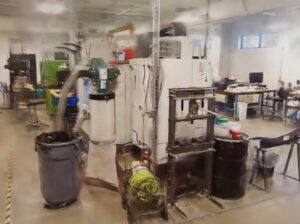

Context: Industrial training workshop
case studies
From scan to floor redesign: how XRintelligence developed an editable 3D workshop for Technifutur
Unlock Case Study
the challenge
Without an operational digital twin
- Critical, heterogeneous equipment (cobots, FANUC robots, Mazak CNC machines) too costly to take offline for training
- Classroom-style sessions that pause live machines and disrupt the workshop
- Machine data disconnected from the space and equipment it describes
- Risk of a one-off 3D showcase instead of infrastructure that lasts
the benefits
With XRintelligence on Prevu3D RealityPlatform™
- Operators trained in VR on critical equipment, with no downtime on the real machines
- Robot motion and machine cycles simulated with real control logic
- Machine KPIs shown in 3D, next to the equipment they describe
- One twin powering tours, simulation, training and dashboards
- Data structure ready for OPC-UA, MQTT and future AI layers
Get Instant Free Access to the From scan to floor redesign: how XRintelligence developed an editable 3D workshop for Technifutur case study
Overview
Technifutur now trains operators inside a virtual copy of its Seraing workshop that looks, moves and behaves like the real one. XRintelligence designed and delivered it end to end, from Lidar (laser-based 3D scanning) capture to a deployed virtual reality (VR) platform. Underneath, Prevu3D provided the reality foundation: the processed 3D capture of the workshop that every later step was built on.
The project shows what happens when accurate reality capture meets real machine logic. The result is not a one-off showcase but reusable infrastructure, built to take on live data and AI as Technifutur’s needs grow.
The real value of this digital twin lies in the convergence of scanning and simulation. LiDAR and XR bring the physical environment to life, while real control logic and machine behavior make the virtual workshop react like the real one. Together, they create a powerful platform for training, testing, and operational readiness.
Thierry Jourquin, CEO, XRintelligence
The challenge
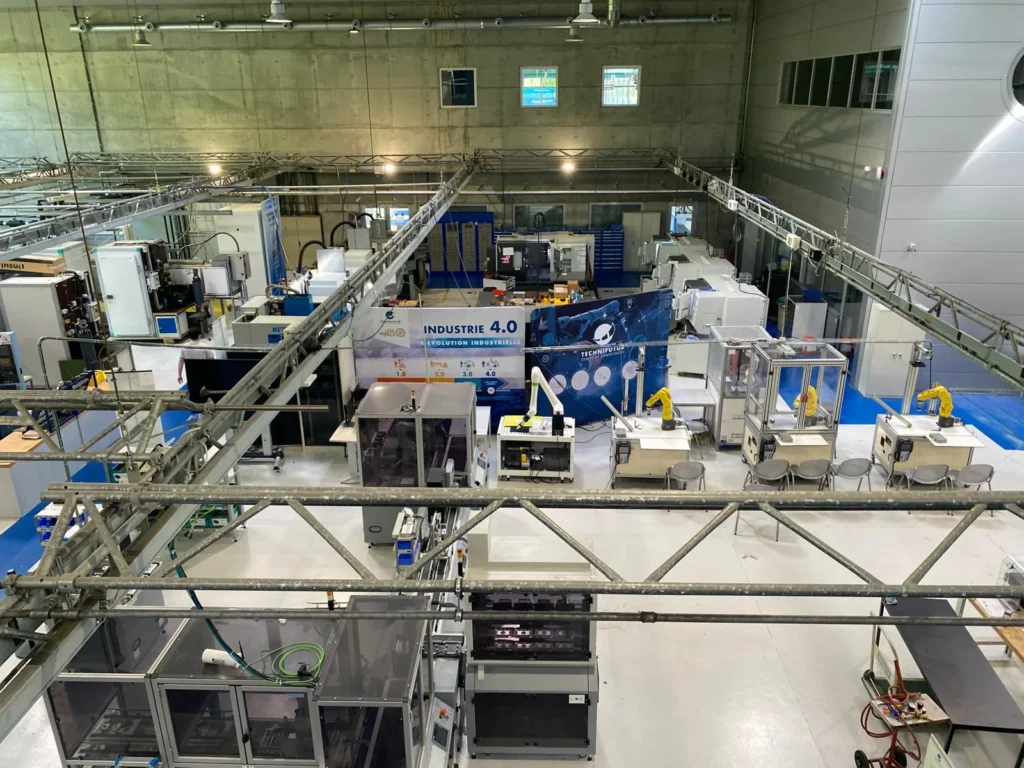
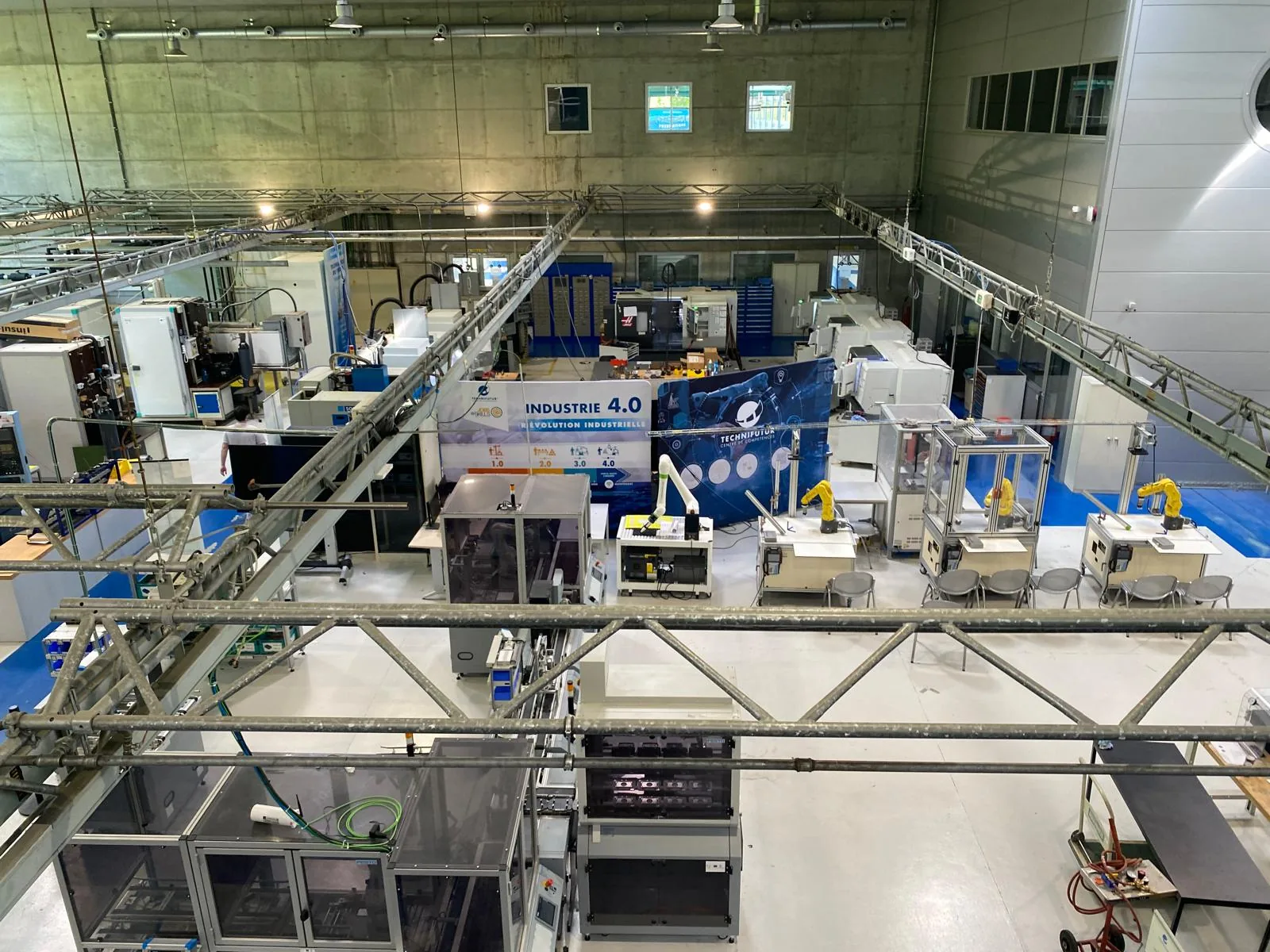
Technifutur’s approximately 200 m² workshop in Seraing brings together cobots, FANUC robots, Mazak CNC machines, Festo equipment and refrigeration systems. To plan changes efficiently, the team needs a realistic reference of the existing space that can evolve as equipment and layouts change.
A traditional point-cloud-to-real-time-3D workflow creates three bottlenecks:
- 3D preparation: Converting a dense point cloud into a clean, manageable mesh is technically demanding and often requires specialist software and skills.
- Layout editing: Removing and replacing machines in Unity, Unreal Engine or conventional 3D tools generally requires an experienced 3D user or developer.
- Stakeholder communication: Presenting different layout options typically adds further work to prepare scenes, camera views and visual content.
The first priority was therefore not VR-based operator training, but a reusable industrial environment for practical shopfloor modifications and decision support.
The solution: an end-to-end spatial digital twin
XRintelligence owned the full chain, from capture to deployment. Its approach combines three disciplines that rarely sit in one team: reality capture, real-time 3D engineering and industrial simulation.
- Capture the workshop as it really is. A mobile Lidar scan with ImmoPass captured the workshop at 600,000 points per second, with centimetre-level accuracy.
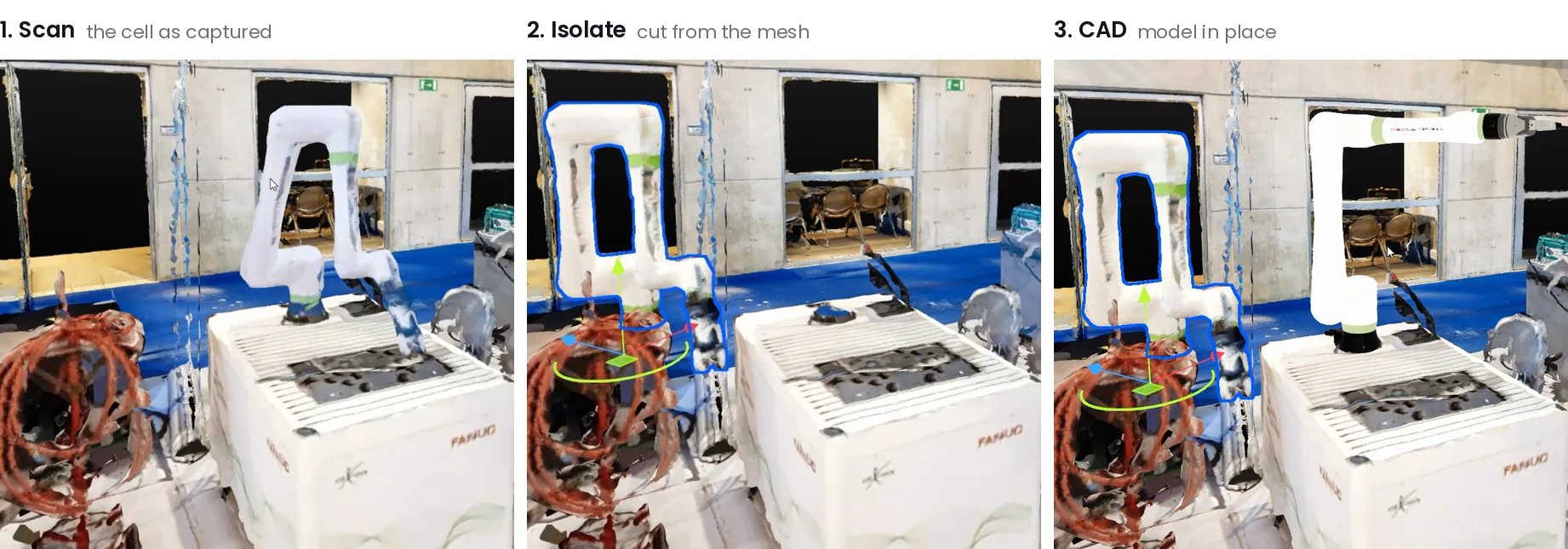
- Build a complete, trustworthy model. The scan produced a full BIM model, a structured 3D model of the building and its components. XRintelligence enriched it with manufacturer CAD data for critical equipment, so each machine is represented with simulation-grade fidelity.
- Make it real-time. The model was transformed into a Unity environment: optimised geometry, levels of detail, robot rigging and animated machine cycles.
- Make it behave. Using realvirtual.io, XRintelligence connected the environment to real control logic, so the virtual workshop reacts the way the physical one does.
- Structure the data for what’s next. Machine tags, states and events were modelled from day one, ready for live connections through OPC-UA, the industrial standard for secure machine-to-machine data exchange, and MQTT, a lightweight messaging protocol widely used to stream live sensor and machine data.
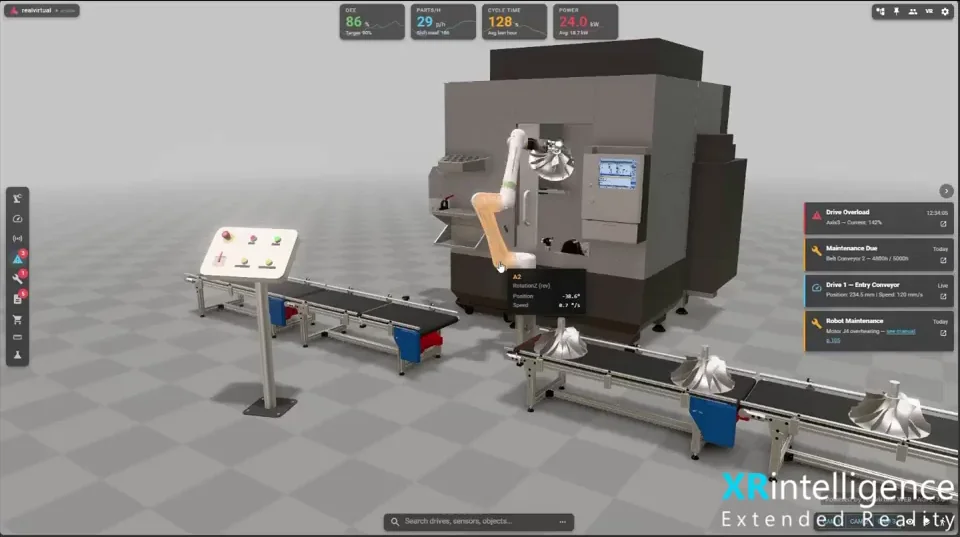 This is where XRintelligence’s positioning shows: XR (extended reality, covering virtual, augmented and mixed reality) builds the world, and data and AI give it meaning. The team designed the twin as an operational layer, not a 3D viewer.
Under the hood: Prevu3D as the reality foundation
XRintelligence’s clients see the result: an immersive, working twin of their site. What makes it possible starts earlier, with Prevu3D RealityPlatform™ turning raw Lidar capture into the 3D data the rest of the workflow is built on.
On this project, XRintelligence used Prevu3D RealityPlatform™ to:
- Point cloud → mesh. Transform captured point-cloud data into a workable mesh, avoiding a difficult preparation step in workflows centred on Unity or Unreal Engine.
- No-code equipment editing. Select, isolate, remove and replace equipment assets through a visual interface, now available on desktop and in the browser, enabling non-developers to make straightforward layout changes.
- Visual scenario communication. Generate alternative views, camera positions and short presentation videos directly from the environment.
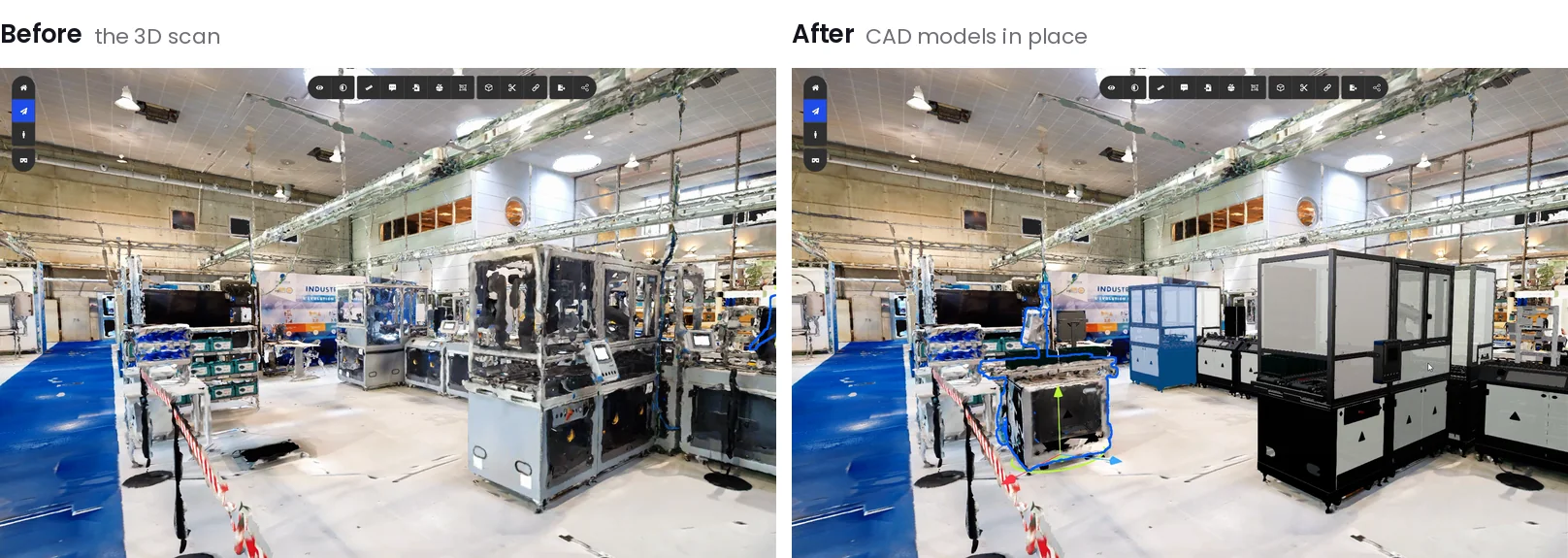
Key proof point: Based on XRintelligence’s experience with Technifutur, Prevu3D delivers an estimated productivity improvement of up to 5× on key stages of the 3D workflow, particularly point-cloud processing, mesh preparation and shopfloor layout editing.
Prevu3D thus helps XRintelligence deliver a practical, editable as-built foundation while reducing the need for 3D development expertise during initial shopfloor redesign.
The wider platform
Industrial organisations have systems of record for products (PLM), business (ERP) and production (MES), but rarely for physical reality.
Prevu3D RealityPlatform™ fills that gap by keeping as-built conditions current and connected. This project used its core capture-to-mesh capabilities. Other parts of the platform were not used here but fit naturally into the next phase.
| Capability | What it does | On this project |
|---|---|---|
| Any reality, one platform | Brings together terrestrial laser scanning (TLS), simultaneous localisation and mapping (SLAM), mobile, drone, 360° and photogrammetry capture, regardless of device or format | Used: mobile Lidar capture processed and meshed |
| RealityAssets™ | Turns captured geometry into persistent, identifiable objects across captures | Next: equipment was segmented and extracted manually; persistent assets would support CAD matching and change tracking over time |
| RealityConnect™ | Delivers reality data into Revit, Inventor, Plant 3D, Teamcenter, NX, Tecnomatix, SolidWorks, MicroStation, Omniverse and via APIs | Next: plugins could replace manual extraction and speed the hand-off into BIM and simulation tools |
| AI-ready physical context | Gives vision models and AI agents structured physical context through APIs (application programming interfaces) and MCP (Model Context Protocol, a standard that lets AI agents connect to data sources) | Next: a natural fit for the AI layer planned for the twin |
As the workshop evolves, with new machines or a changed layout, a fresh capture can be compared against the existing twin to show what changed. That keeps the training environment aligned with the real workshop over its lifetime.
The outcome
The initial Technifutur use case focuses on a usable, editable spatial digital twin for shopfloor planning and communication. Its principal benefits are:
- Immersive workshop tours for trainees, visitors and partners, anywhere, at any time
- Machine simulation in VR, with rigged robots and animated machine cycles driven by real control logic
- Operator training scenarios on critical equipment, with no downtime on the real machines
- Spatial 3D dashboards that show machine KPIs in place, next to the equipment they describe
Because every use runs on the same twin, each new scenario builds on existing assets instead of starting over.
What’s next: from shopfloor redesign to operational intelligence
The twin’s data structure is already prepared for OPC-UA and MQTT. The next step is connecting live machine data, so the virtual workshop mirrors the physical one in real time.
That opens the door to the intelligence layer both partners are building towards: anomaly detection, predictive insights and AI assistants that reason over the workshop’s real layout and machine state. None of this was part of the first phase, but the foundations are in place.
XRintelligence brings the simulation and XR expertise to act on that intelligence. Prevu3D can extend its role in two ways: RealityConnect™ plugins to automate the hand-off from scan to BIM and simulation tools, and RealityAssets™, APIs and MCP to give AI structured context about the physical workshop.
about The partner
XRintelligence
XRintelligence designs spatial digital twins for industrial decision and performance. Its systems connect real-time 3D environments, operational data and AI to help organisations understand, simulate and pilot complex operations.
The team covers the full chain, from 3D capture and BIM to VR, AR, mixed reality, simulation and AI. Clients include Thales, SNCB, Duracell, AISIN, Air Products, Ethias, the Atomium and Orange.
XRintelligence is based in Louvain-la-Neuve and at the A6K Industrial Hub in Charleroi, Belgium.
about us
Prevu3D
Prevu3D RealityPlatform™ is the system of record for physical reality. It turns scans, point clouds and models into a persistent, structured layer that engineering, operations and AI can use inside the tools they already work in.
Industrial leaders including P&G, Toyota, DB, Mars, DENSO, Tetra Tech and WSP rely on Prevu3D to keep as-built conditions current across sites.